
On this page
- What it is
- Pragmatics is the branch of linguistics that studies how the situation of an utterance contributes to its meaning.
- The problem until now
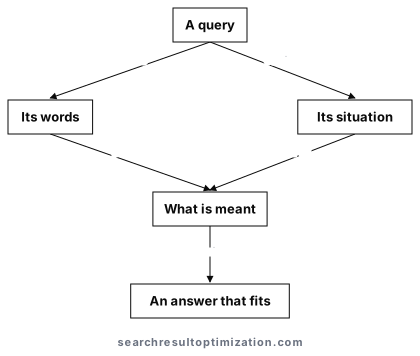
- Search work treated the query as a string of words, so the part of the meaning that the situation carries had no name, and the four mechanisms that carry it stood in four separate places.
- What you can do from here
- You can name the part of a query that its words leave out, tell the four mechanisms apart, and write the page that answers the situation as well as the string.
Contents14
Tests on this page you have run: 0 of 4. The count stays in this browser only.
Jump to a test4
A person on the street asks whether you have any spare change. Nobody hears a question about the contents of your pocket.
Pragmatics is the name for the part of meaning that the situation supplies. It has been studied for a century, and four of its mechanisms decide what a search query means. This page states what is settled, names the four, and says what each one changes about a page.
Every heading is a question. The answer stands directly under it, in plain words.
What is pragmatics?
Pragmatics is the branch of linguistics that studies how the context of an utterance contributes to its meaning. The same words mean different things in different situations, and the difference is orderly enough to be described. A query is an utterance, so everything pragmatics established applies to it.
“Pragmatics is the study of linguistic acts and the contexts in which they are performed”
Reference: Stanford Encyclopedia of Philosophy, Pragmatics. https://plato.stanford.edu/entries/pragmatics/
Where does semantics end and pragmatics begin?
Semantics describes what the words of a sentence mean by convention. Pragmatics describes what a speaker means by uttering them here, now, to this listener. The sentence do you have any spare change has one conventional meaning and several speaker meanings, and the situation picks one.
“more is involved in what one communicates than what one literally says”
Reference: Stanford Encyclopedia of Philosophy, Pragmatics. https://plato.stanford.edu/entries/pragmatics/
What is speaker meaning?
Speaker meaning is what a person intends to communicate, as distinct from the standing meaning of the words. Paul Grice introduced the distinction in 1957 and built the modern field on it. A search system receives the words and has to infer the rest.
What is deixis, and where does it appear in a query?
Deixis is the use of expressions whose reference depends on the situation of utterance: here, now, this, you, near me. A query full of deictic words is readable only with a situation attached, which is why best restaurant near me means one thing in Frankfurt at eight in the evening and another in Hamburg at noon.
Try it now
- Search
near metogether with your own subject on Google. - Then, close the window.
- Think and search: what did the result page assume about where you are, and what would change if you were elsewhere?
How much of the answer was supplied by your situation rather than by your words.
“is the use of words or phrases to refer to a particular time”
Reference: Wikipedia, Deixis. https://en.wikipedia.org/wiki/Deixis
What is the cooperative principle?
Grice described conversation as a cooperative undertaking in which speakers say as much as is needed, no more, and keep what they say relevant, true and clear. Listeners assume this and infer accordingly. A searcher types three words and expects the system to behave like a cooperative partner who fills in the rest.
What is common ground between a searcher and a search system?
Common ground is what the parties to an exchange treat as shared and settled. Between two colleagues it is thick; between a searcher and a search system it is thin, and the searcher usually assumes it is thicker than it is. Most disappointing results come from that gap.
Try it now
- Write down one three-word query a client of yours would type.
- List everything a good answer would have to know that the three words leave out.
- Then, close the window. Think and search: does any page in the top ten name even one of those conditions?
The distance between what the query says and what an answer needs.
Which four mechanisms carry the meaning of a query?
Four, and each has its own page here. Presupposition in search queries is what the query takes for granted. Conversational implicature: what queries and pages mean without saying it is what it suggests without saying. Speech act theory: what a query does are what it does, beyond describing. Relevance theory and what relevance means in search is the reader's balance of effect against effort. Taken together they account for the part of a query its words leave out.
| Who | What to do | Free means | What it shows |
|---|---|---|---|
| Searcher | Take your last unsatisfying search and ask which of the four was missed | A notes app | Which mechanism the answer ignored |
| SEO | Sort your main queries into the four mechanisms | Search Console queries tab, a spreadsheet | Which mechanism your pages already serve |
| Your site | Check your own domain; replace example.com with it | site:example.com intitle:"what is" OR intitle:"how to" | Pages that answer words alone |
| Who benefits | In everyday use | How it pays off |
|---|---|---|
| Content team | Names the part of demand its pages ignore | Visibility for needs competitors answer by accident |
| SEO | Sorts queries by mechanism | A map of what the words leave out |
| Readers | Gets the answer to the question behind the question | Fewer searches, better decisions |
Where did pragmatics come from?
Charles W. Morris divided the study of signs in 1938 into syntactics, semantics and pragmatics, and pragmatics was the part concerned with the relation between signs and their users. Linguistics adopted the division, and the field grew from Austin, Grice and Searle into the discipline it is now.
Which parts of pragmatics have reached machine standards?
Speech acts have. Dialogue act annotation is published as an international standard, ISO 24617-2, so a machine can record what an utterance does in a way another machine can read. Presupposition, implicature and relevance are described in the literature and carried into systems by hand, one design decision at a time. The gap between those two states is where most answer quality is decided.
Try it now
- Search
"dialogue act" annotation standardon Google. - Then search
"implicature" annotation standard. - Then, close the window. Think and search: which of the two brought back a norm, and which brought back papers?
Which part of meaning has been written down for machines, and which part is still handled by people.
What does pragmatics mean for the systems that read a query?
The system receives the words and has to reconstruct the situation. It has fragments to work with: place, time, device, the queries that came before, the language used. Everything else it assumes. Conversational systems make the problem visible by taking a sequence of turns, where each turn changes what the next one means.
“Conversational information seeking”
Study: Zamani, Trippas, Dalton and Radlinski, Conversational Information Seeking, 2022. https://arxiv.org/abs/2201.08808
What does information retrieval call the same thing?
Its own names, and they are older than the search industry. Patrick Wilson published situational relevance in 1973: the worth of an item measured against the question a person actually carries. Context-aware information retrieval adjusts ranking by the circumstances of the search. Extralinguistic context, user location and temporal anchor are the system-side names for the situation of utterance, for place deixis and for time deixis. One subject, two vocabularies, and the two rarely cite each other.
Try it now
- Search
"situational relevance"on Google. - Then search
user intent. - Then, close the window. Think and search: did the two searches bring back one field or two that never mention each other?
Two vocabularies for one subject, and the distance between them.
“Situationally relevant items of information are those that answer, or logically help to answer, questions of concern”
Study: Patrick Wilson, Situational Relevance, Information Storage and Retrieval 9(8), 1973. https://eric.ed.gov/?id=EJ084928
What changes on a page that answers the situation as well as the words?
It names the assumption behind the query in plain words, gives the answer for the case where the assumption holds, and gives the answer for the case where it fails. It says who it is written for and when it applies. A page built that way holds up when the query arrives with a different situation attached, and it survives being summarised, because the conditions travel with the answer.
| Who | What to do | Free means | What it shows |
|---|---|---|---|
| Searcher | Look for the conditions under which a page's advice holds | Any result page | Whether the advice is yours |
| SEO | Add the failing case to your three strongest pages | Your CMS | Answers that survive a different situation |
| Your site | Open one page and mark every sentence that names a condition | A printout and a pen | How much of the page is conditional |
How do you write for a situation you can only infer?
State the conditions. A sentence that begins if you are looking at this before signing gives the reader a test for whether the answer is theirs. It also gives an answer system something it can carry over: the condition belongs to the sentence, so it travels with the quote.
| Who benefits | In everyday use | How it pays off |
|---|---|---|
| Content team | Writes conditions into sentences | Quotable answers that carry their limits |
| SEO | Sees which conditions users actually arrive with | Segments nobody else serves |
| Readers | Can tell whether an answer is theirs | Trust earned in one sentence |
First published 2026-09-16. Last revised 2026-09-16.