
On this page
- What it is
- Deixis is the use of expressions whose reference is fixed by the situation of speaking: here, now, this, you, near me.
- The problem until now
- Pages were written in the reader's present tense, so sentences that were true at the moment of writing kept being served, quoted and summarised long after the situation they pointed at had gone.
- What you can do from here
- You can find the deictic words in your own pages, replace the ones that decay, and write sentences that stay true when a machine lifts them out of the page.
Contents12
Tests on this page you have run: 0 of 3. The count stays in this browser only.
Jump to a test3
Best pizza near me is four words. Two of them carry no meaning at all until the phone answers where the person is standing.
Linguistics calls those words deictic, and it has described them for a century: person, place, time, discourse and social standing. This page states what is settled, shows where each kind appears in a query, and says what happens to a deictic sentence when an answer system quotes it.
Every heading is a question. The answer stands directly under it, in plain words.
What is deixis?
Deixis is the use of expressions whose reference is supplied by the situation of utterance rather than by the words themselves. Here, now, this, you, near me and today are the everyday examples. Philosophers call the same expressions indexicals.
“a linguistic expression whose reference can shift from context to context”
Reference: Stanford Encyclopedia of Philosophy, Indexicals. https://plato.stanford.edu/entries/indexicals/
What is the deictic centre?
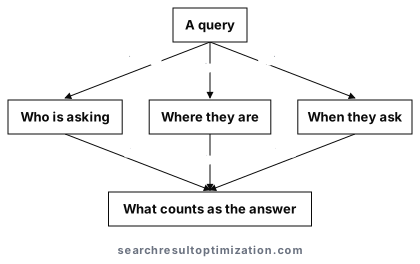
The deictic centre is the point the expressions are measured from: the speaker, their location, and the moment of speaking. Every deictic word is an instruction to measure from that point. In a search query the centre is the person typing, and the system reconstructs it from the device, the connection and the clock.
“Deixis exists in all known natural languages”
Reference: Wikipedia, Deixis. https://en.wikipedia.org/wiki/Deixis
Which kinds of deixis appear in a query?
Five. Person: my, for me, our company. Place: near me, nearby, local, in my area. Time: today, now, current, this year, latest. Discourse: this one, the above, in a follow-up question. Social: the level of formality a query assumes, visible in whether it asks for the beginner version or the professional one.
What does near me actually mean to a search system?
It means the coordinates the device reports, widened to whatever radius the system considers reasonable for the subject. The same three words produce a different result set on every street corner, and the searcher has no way to see the radius. For a business, the phrase is a boundary drawn around the searcher, and the page has to earn its place inside that boundary rather than on the whole map.
Try it now
- Search
near mewith your own subject on your phone. - Walk two streets and search the same words again.
- Then, close the window. Think and search: how much of the result set moved, and was your page inside both?
The radius the system drew around the searcher, and whether you were in it.
Why does a page with the word currently decay?
Because currently points at the moment the sentence was written and keeps pointing there while the page stays online. A reader arriving two years later measures from their own moment, and the sentence quietly says something false. The same holds for this year, recently, the new and at the time of writing.
Try it now
- Open your most important page and search it for
currently,this year,recently,at the moment. - Write down each sentence and the year it was true.
- Then, close the window. Think and search: which of them is still true today?
How many sentences on the page are quietly out of date.
What happens when an answer system quotes a deictic sentence?
The anchor is left behind. A summary lifts the sentence out of the page, away from its date, its author and its place, and the words that were measured from those things now measure from nothing. A sentence that reads prices are currently around 40 euro becomes a claim with no time attached, and it is repeated as long as the summary lives.
Try it now
- Ask an answer engine a question your page answers.
- Read the answer it gives and look for the time and place anchors.
- Then, close the window. Think and search: would that sentence still be true if somebody read it next year?
What a summary keeps and what it drops.
“Two speakers who utter a single sentence that contains an indexical may say different things”
Reference: Stanford Encyclopedia of Philosophy, Indexicals. https://plato.stanford.edu/entries/indexicals/
How do you anchor a sentence so it survives being quoted?
Name the thing the word was pointing at. Write in September 2026 instead of currently, in Frankfurt am Main instead of here, for a company with fewer than ten employees instead of for you. The sentence then carries its own conditions, and it stays true wherever it is copied.
| Who | What to do | Free means | What it shows |
|---|---|---|---|
| Searcher | Check whether an answer names its date and place before you act on it | Any answer engine | Whether the advice is current |
| SEO | Replace relative time words with named dates across the top pages | Your CMS, a search for currently and this year | Sentences that stay true in a summary |
| Your site | Check your own domain; replace example.com with it | site:example.com "currently" | Pages carrying an undated claim |
| Who benefits | In everyday use | How it pays off |
|---|---|---|
| Content team | Names dates, places and cases in the sentence itself | Quotes that stay true wherever they travel |
| SEO | Finds and replaces decaying time words | Pages that age slowly |
| Readers | See when and where an answer applies | Decisions made on current facts |
What does information retrieval call the same thing?
User location and temporal anchor, on the system side. In retrieval, place and time are attributes that adjust ranking. In linguistics, they are the point an expression is measured from. Same phenomenon, two vocabularies, and the linguistic one is a century older.
Which queries carry a hidden deictic centre?
More than the obvious ones. Best crm carries an unspoken for a company like mine. Interest rates carries today. Is it worth it carries at my income, in my situation. The words are absent and the measurement still happens, which is why a page that names the case it serves outperforms a page that answers the query as typed.
| Who benefits | In everyday use | How it pays off |
|---|---|---|
| Content team | Writes the case the page serves into the page | Visibility for people the query left unnamed |
| SEO | Sorts queries by the situation they assume | Segments competitors answer by accident |
| Readers | Recognise their own case in the first lines | Less time spent on answers for somebody else |
What changes on a local business page?
It stops describing its position relative to itself. We are centrally located measures from the business; eight minutes on foot from Frankfurt Hauptbahnhof measures from a point the reader can find. The second sentence works in a summary, in a voice answer and in a printout.
| Who | What to do | Free means | What it shows |
|---|---|---|---|
| Searcher | Measure the distance from a landmark you know | A map | Whether the place is reachable for you |
| SEO | Rewrite location sentences to measure from public landmarks | Your CMS | Directions that work without the page |
| Your site | Check your own domain; replace example.com with it | site:example.com "centrally located" OR "in the heart of" | Sentences that measure from themselves |
What is social deixis?
The part of an utterance that encodes the relationship between the people in it: formal and informal address, honorifics, titles, the register a question is asked in. In search it appears as the difference between a query that wants the introduction and a query that wants the specification, and a page that answers in the wrong register is read as written for somebody else.
First published 2026-09-16. Last revised 2026-09-16.