
On this page
- What it is
- Optimizing search results means changing what a person sees, understands and can act on when a result page answers their question.
- The problem until now
- The advice was sorted by technique, so a page could pass every checklist and still put nothing on the result page that a reader could use.
- What you can do from here
- You can sort your own work into four groups, see what each group changes for the reader, and spend your effort where it arrives.
Contents12
Tests on this page you have run: 0 of 3. The count stays in this browser only.
Jump to a test3
Ask how to optimize search results and you are told about titles, speed, links and sitemaps. Every one of those answers describes the sending side.
The four groups below cover that work honestly, because it has to be done. Each one also states the part that is usually left out: what changes for the person who sees the result. Every heading is a question, and the answer stands directly under it.
What does it mean to optimize search results?
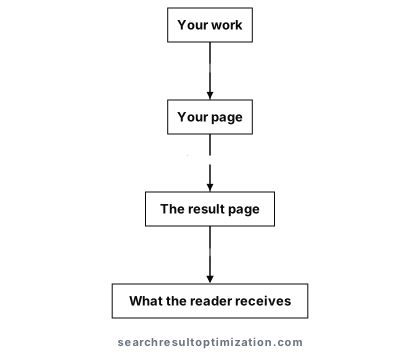
It means influencing what appears on a result page, and what a person can do with it. The page you publish is one input. The result a searcher sees is assembled by the engine from your page, from what it knows about the query, and from whatever else it decides to place above you.
“is a web page that is displayed by a search engine in response to a query by a user”
Reference: Wikipedia, Search engine results page. https://en.wikipedia.org/wiki/Search_engine_results_page
Group one: what belongs to language and content?
Title tag, meta description, structured data, rich results and the handling of duplicate content. Read what you did not read about language and content: what you write in a title is a proposal. The engine reads the whole page and frequently writes its own title link from a heading or from the text, especially when your title repeats the same words for every page. The sentence that carries your meaning belongs in the visible text, where it can be quoted.
Try it now
- Search your own brand together with one of your subjects on Google.
- Compare the title shown in the result with the title you wrote.
- Then, close the window. Think and search: which of the two describes the page better?
How often the engine writes its own title link for your pages.
Group two: what belongs to the requirements?
E-E-A-T, crawl budget, mobile-first indexing, the features a result page can show, the knowledge graph, and domain authority. Read what you did not read about requirements: they come from two different places. Google publishes some of them. Domain authority and comparable scores are models built by tool vendors, useful for comparing sites with each other, and separate from anything the engine computes.
Also discussed at https://www.searchresultoptimization.com/seo/eeat/
Group three: what belongs to the measurable values?
Core Web Vitals, loading time, ranking positions, indexability and crawlability. Read what you did not read about measurable values: a number that improves is worth something when a reader notices the difference. Half a second on a page that answers the wrong question changes nothing, and a green score has never persuaded anybody to read on.
Group four: what belongs to the site technology?
XML sitemap, robots.txt, canonical tags, internal linking, the backlink profile and the technical audit. Read what you did not read about site technology: these are preconditions. They decide whether your page can be reached and understood at all, and they produce nothing on their own. A perfectly crawlable page with nothing to say is perfectly crawlable and unused.
Which part of this work reaches the person reading?
The title link, the snippet, whatever rich result your markup earns, and the sentence a summary lifts out of your text. Everything else works on the way there. That is the whole reason the four groups are worth keeping apart: the last few centimetres of the journey decide whether the rest of it mattered.
| Who | What to do | Free means | What it shows |
|---|---|---|---|
| Searcher | Read the result page before opening anything, and note what you already know | Any search | How much the result gave you |
| SEO | List, per page, which sentence you want an answer engine to quote | A spreadsheet, one row per page | The sentence worth writing carefully |
| Your site | Check your own domain; replace example.com with it | site:example.com intitle:"what is" | Pages competing for a definition |
| Who benefits | In everyday use | How it pays off |
|---|---|---|
| Content team | Writes the sentence that can be quoted | Presence in answers written by machines |
| SEO | Reports what arrives instead of what was done | Effort spent where it shows |
| Readers | Get the answer in the result itself | Time saved |
Try it now
- Put a question your page answers to an answer engine.
- Read the answer and look for a sentence that came from your page.
- Then, close the window. Think and search: would that sentence still be useful without the rest of your page?
Which of your sentences can travel on its own.
What does a result page owe the person who searched?
By Google's own published policy, a featured snippet on a subject of public interest is held to the state of expert agreement. The engine takes responsibility for what it puts in that box, which is a useful thing to know when you write the passage it might use.
“Featured snippets about public interest content shouldn’t contradict well-established or expert consensus”
Reference: Google Search Help, Featured snippets and your website. https://support.google.com/websearch/answer/9351707
What is discussed under the name SEO Avalanche Technique?
A way of building visibility from a standing start: begin with terms so specific that almost nobody competes for them, publish until those rank, then move one step up in volume, and repeat. The idea was written up in a public forum thread and has been passed around since. It is practitioner knowledge rather than published research, and it is discussed at https://www.buildersociety.com/threads/seo-avalanche-technique-ranking-with-no-resources.5114/.
What is the Keyword Golden Ratio, and where does it stand?
A rule of thumb from keyword research: divide the number of pages carrying the phrase in their title by the monthly search volume, and treat a result under 0.25 as a term worth writing for, provided the volume stays under 250. As of September 2026 there is no study that establishes it and none that refutes it. The documented objections are worth carrying: the title counts move from hour to hour, volumes differ between tools, and a low count says nothing about the strength of the pages already there.
What does the allintitle operator actually count?
It restricts the result set to pages carrying all of your words in their title, and the figure Google displays for it is an estimate rather than a count. Used as a rough reading of how many people wrote directly on a subject, it is informative. Used as a decimal in a formula, it carries more precision than it has.
| Who | What to do | Free means | What it shows |
|---|---|---|---|
| Searcher | Compare the operator count with the plain count for one question you have | Whether anyone wrote on it directly | |
| SEO | Run the comparison for your ten most important subjects | Google, a spreadsheet | Subjects with room left in them |
| Your site | Check your own domain; replace example.com with it | allintitle:"your subject" site:example.com | Whether you treated the subject or mentioned it |
Try it now
- Search
allintitle:"your exact phrase"on Google. - Note the number of results, then search the phrase without the operator.
- Then, close the window. Think and search: how many people wrote directly about this, and how many only mentioned it?
The distance between a subject being mentioned and a subject being treated.
What changed once answers began to replace visits?
The work in the four groups still has to be done, and the destination moved. A result that answers on your behalf makes the readable sentence more valuable than the ranked position, because the sentence is what travels. That is the subject of answer engine optimization, and it is where the same effort now pays.
| Who benefits | In everyday use | How it pays off |
|---|---|---|
| Content team | Writes passages that survive a summary | Named in answers, not only ranked |
| SEO | Measures appearances as well as positions | A picture of the new surface |
| Readers | Receive answers that carry their conditions | Decisions on current facts |
First published 2026-09-17. Last revised 2026-09-17.