
On this page
- What it is
- Trust in media is the readiness of an audience to take a report as true without checking it.
- The problem until now
- It was reported as a survey number per outlet, so nobody could say what produced the number or what would change it.
- What you can do from here
- You can name the mechanism behind a reaction, tell refusal from avoidance, and see why a correction sometimes makes a belief stronger.
Contents21
Tests on this page you have run: 0 of 5. The count stays in this browser only.
Jump to a test5
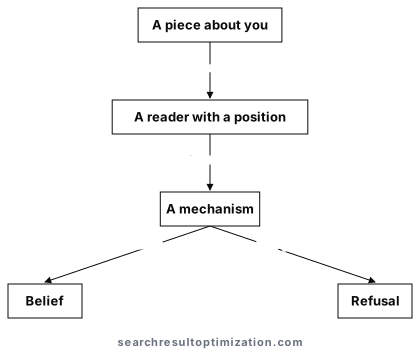
Two readers see the same article. One takes it as proof, the other as evidence of bias. The article is identical.
Surveys measure the result and call it trust. This page states what the surveys establish and then the mechanisms that produce the number, because only the mechanisms can be worked with. Every heading is a question. The answer stands directly under it, in plain words.
What do the surveys establish?
That confidence in news organisations has fallen to historic lows, that the gap between political camps has widened, and that younger audiences take their news from social platforms while trusting those platforms unevenly. Long-run series from large survey institutes carry this, with the usual sampling error attached to small year-on-year moves.
What is the hostile media phenomenon?
The finding that committed partisans on both sides read the same balanced report as biased against their own camp. It is the most robust result in this field and the least comfortable one: a piece can be fair and be received as an attack by everybody involved.
What do the survey numbers leave out?
The mechanism. A number says how much trust exists; it does not say what produced it, what would change it, or why a correction sometimes strengthens the belief it was meant to fix. The sections below name the mechanisms that psychology has described and that communication reporting rarely mentions.
What is motivated reasoning?
Reasoning that serves a conclusion the person already prefers. Evidence that fits is examined lightly, evidence that threatens is examined hard. It explains the common failure of correction campaigns: supplying more accurate facts to somebody who has a reason to reject them supplies more material to reject.
| Who benefits | In everyday use | How it pays off |
|---|---|---|
| Management | Stops expecting facts alone to change a position | Budgets spent where they can work |
| Content team | Writes for the reader who can be reached | Material with an effect |
| Customer support | Recognises rejection that has nothing to do with the product | Calmer conversations |
What is selective exposure?
The choice of sources that already agree. It matters for coverage because it decides who ever sees a piece. A placement in an outlet your critics avoid reaches the people who were persuaded already.
What is the illusory truth effect?
Repetition makes a statement feel true, whatever its source. For an organisation this cuts both ways: a false claim repeated across three small outlets can outweigh one correction in a large one, and a true statement repeated in your own words gains the same familiarity.
Try it now
- Take one claim about your organisation that you consider false.
- Search it in quotation marks and count the pages that repeat it.
- Think: how many repetitions stand against how many corrections?
The balance between a claim and its answer.
| Who | What to do | Free means | What it shows |
|---|---|---|---|
| Searcher | Search a claim about the organisation in quotation marks and count how often it repeats | "the exact claim" | How far a claim has travelled by repetition |
| SEO | Answer a repeated false claim in your own words on your own page, with a source | Your CMS | A correct version that can be repeated |
| Your site | Check your own domain; replace example.com with it | site:example.com "correction" OR "clarification" | Whether corrections exist on your own domain |
“tendency to believe false information to be correct after repeated exposure”
Reference: Wikipedia, Illusory truth effect. https://en.wikipedia.org/wiki/Illusory_truth_effect
What is the sleeper effect?
The delayed influence of a low-credibility source. Over time people remember the claim and forget where it came from, so a dismissible piece can become an undisputed impression weeks later. That is why a weak source is worth answering, even when nobody took it seriously at the time.
What is source memory, and why does it decide the value of a citation?
Source memory is the recall of where a statement came from. It is weaker than memory for the statement itself, which is the quiet problem with being quoted: the sentence travels, the attribution falls away. In generated answers the same thing happens mechanically.
Try it now
- Ask a colleague where they heard one fact about your market.
- Note the answer in your own words.
- Think: did the claim survive while its source disappeared?
How fast attribution falls away.
What is psychological reactance?
The push-back that follows a message experienced as pressure. Campaigns written to persuade can produce the opposite of persuasion in an audience that already suspects motives. The practical consequence is a change of form: evidence that a reader can check produces less reactance than an appeal that asks to be believed.
What is identity-protective cognition?
Evaluating information by what accepting it would cost inside one's own group. It looks like a factual disagreement and behaves like a loyalty test. Where it is at work, better data changes nothing, and a shift comes only from somebody the group already trusts.
What is naive realism?
The assumption that one sees the world as it is, and that people who disagree must be biased or misinformed. It is the reason two camps can each cite the same article as proof of the other side's bias.
What is the third-person effect?
The belief that media affect other people more than oneself. It shapes what audiences demand: measures aimed at protecting others, and resistance to anything that treats oneself as susceptible.
“tend to perceive that mass media messages have a greater effect on others than on themselves”
Reference: Wikipedia, Third-person effect. https://en.wikipedia.org/wiki/Third-person_effect
What is affective polarization?
Hostility towards the other camp as people, apart from any disagreement about policy. Where it is high, an outlet is judged by who else reads it, and a placement can damage standing with one audience precisely because it persuaded another.
Try it now
- Take your last placement and read the comments under it.
- Put them aside for a moment.
- Think: how much of the reaction is about you, and how much is about the outlet?
The part of a reaction that the outlet carried.
What is belief perseverance, and why do corrections disappoint?
Beliefs survive the removal of the evidence that produced them. A correction reaches the record and rarely reaches the impression. The realistic goal of a correction is the archive and the next reader, rather than the mind that already decided.
| Who benefits | In everyday use | How it pays off |
|---|---|---|
| Legal and compliance | Corrects for the record and expects no change of mind | Documentation that holds |
| Management | Judges a correction by what it preserves | Realistic expectations |
| Content team | Publishes the corrected version in its own words | A source the next reader finds |
What is news avoidance?
The deliberate turning away from news, often for reasons of mood and overload rather than disbelief. It is routinely counted as distrust, and the two require opposite responses: distrust asks for evidence, avoidance asks for relevance and brevity.
Try it now
- Ask three people outside your field why they skipped a story about your industry.
- Write down the reasons.
- Think: was it disbelief, or was it fatigue?
Two different problems that look alike in a survey.
| Who | What to do | Free means | What it shows |
|---|---|---|---|
| Searcher | Ask three people outside the field why they skipped a story | A notes app | Whether the reason is disbelief or fatigue |
| SEO | Shorten one central page until the answer stands in the first screen | Your CMS | Material that survives an avoidant reader |
| Your site | Check your own domain; replace example.com with it | site:example.com intitle:summary OR intitle:overview | Pages that answer without demanding time |
What is epistemic vigilance?
The ordinary human capacity to filter what is heard: who says it, what interest they have, whether it coheres with what is known. Scepticism read through this lens is a working faculty rather than a defect, and material that survives it is material that names sources and admits limits.
What is institutional trust, and why is it not a newsroom problem alone?
Confidence in institutions moves together: press, courts, administration, science. A decline in one is rarely explained by the conduct of that one. For an organisation this means the ground can shift without any change in what it does or how it is covered.
What is critical media literacy?
The competence to judge sources, claims and interests. It is the audience-side answer, and it is the one that outlasts a campaign. Material that teaches a reader to check is the only kind that keeps working when the reader no longer trusts anyone, including you.
What does all this mean for coverage about an organisation?
Five things. Repetition beats volume. A weak source is worth an answer. A correction serves the record rather than the impression. Persuasion in the wrong form produces resistance. And material that lets a reader check something survives the loss of trust in everybody, which is the condition the surveys actually describe.
What does it mean for generated answers?
That a judgement can travel as a fact. A passage from an opinion piece carries the writer's position and enters an answer without it. Source memory fails in the same direction, only faster, because the system separates claim and attribution by design. The check is the same as for a human reader: does the sentence name what it rests on?
Try it now
- Ask an assistant what people think about your organisation.
- Note the answer in your own words.
- Think: which sentence is a judgement wearing the clothes of a fact?
Opinions that arrive as findings.
| Who | What to do | Free means | What it shows |
|---|---|---|---|
| Searcher | Ask an assistant what people think of the organisation and look for the source of each judgement | Any free assistant | Judgements that arrive as facts |
| SEO | Log the sentences assistants repeat about the brand, with dates | Google Sheets | The claims that need a checkable answer |
| Your site | Check your own domain; replace example.com with it | site:example.com "according to" OR "source" | Statements of yours that carry their evidence |
| Who benefits | In everyday use | How it pays off |
|---|---|---|
| Legal and compliance | Finds opinions repeated as statements of fact | Early correction where it is cheapest |
| SEO | Tracks which sentences assistants repeat | A record instead of a hunch |
| Content team | States the evidence inside the sentence | Material that survives extraction |
First published 2026-09-16. Last revised 2026-09-16.