
On this page
- What it is
- Stakeholder engagement is the organised involvement of the groups an organisation affects or depends on.
- The problem until now
- The literature described the process and the goodwill, and left out the vocabulary for the cases where participation is arranged, exhausted or quietly ignored.
- What you can do from here
- You can name what you are looking at, check a consultation against the parts that can be audited, and see where a result rests on silence.
Contents21
Tests on this page you have run: 0 of 5. The count stays in this browser only.
Jump to a test5
A consultation with a full room, a printed report and no consequence is indistinguishable from a real one, unless you have the words for the difference.
This page states what is settled in stakeholder engagement, and then the terms that decide whether the process meant anything. Every heading is a question. The answer stands directly under it, in plain words.
What is stakeholder engagement?
The organised involvement of the individuals and groups an organisation affects, or that can affect it: neighbours, employees, suppliers, customers, authorities, associations. It covers identifying them, understanding their interests, and involving them in decisions that touch those interests.
What is settled about the practice?
A great deal. Stakeholder analysis weighs interest and influence, stakeholder mapping makes both visible, an engagement plan names objectives, channels and feedback, and international guidance such as ISO 26000 embeds engagement in social responsibility. Two-way symmetrical communication describes the ideal: dialogue rather than broadcasting, with the possibility that the organisation changes its mind.
What is usually left out?
The vocabulary for the hard cases. The settled account describes how participation is organised, and stops before the terms that say whether it worked: which groups actually count, what exhaustion does to a process, when consent is a legal right rather than a courtesy, and what the difference is between a changed policy and a changed press release.
What is stakeholder salience, and why does it decide everything before the first meeting?
Salience is the attention an organisation grants a group, usually along three lines: how much power it has, how legitimate its claim looks, and how urgent it is. It explains why an investor with a telephone number is heard before a neighbourhood with a petition. Naming it turns an invisible ranking into a decision that can be argued about.
Try it now
- Take the participant list of your last consultation.
- Put it aside for a moment.
- Think: who is affected by the decision and appears nowhere on that list?
The ranking that happened before the first meeting.
| Who benefits | In everyday use | How it pays off |
|---|---|---|
| Management | Sees the ranking that decides who is heard | Decisions that can be defended |
| Legal and compliance | Finds the group whose claim carries a legal weight | Risk addressed before escalation |
| Readers | Understand why some voices arrive earlier | Trust in the process |
What is stakeholder fatigue?
The exhaustion of people who have been consulted repeatedly without seeing a consequence. It matters for a practical reason: the dropouts do not appear in the result. A process that started with forty objections and ends with four can be reported as consensus, when it is attrition.
Try it now
- Compare the number of participants in the first session with the last one.
- Note both numbers.
- Think: was the agreement at the end a result, or the remainder?
Whether consensus was reached or eroded.
| Who benefits | In everyday use | How it pays off |
|---|---|---|
| Management | Reads dropouts as a signal rather than as agreement | Results that mean something |
| Content team | Reports objections with answers, not attendance figures | A record that holds |
| Legal and compliance | Sees where consent was assumed | Fewer disputes later |
What is a social licence to operate?
The informal acceptance a project holds in the community around it, beside the formal permits. It has no document and no expiry date, and it decides whether a legally approved project proceeds or stalls. Organisations notice it only when it is gone.
What is greenwashing, in the exact sense?
Communication that presents an organisation, a product or a policy as environmentally better than the evidence supports. The term names a communication practice, and it applies to a claim rather than to a company. In an engagement process, the question is narrow and answerable: does each environmental claim made in the consultation have a source that a participant could check?
Try it now
- Take one environmental claim from your own material.
- Search for the source it rests on.
- Think: could a participant check it in five minutes?
Claims that carry a source, beside claims that carry a tone.
| Who | What to do | Free means | What it shows |
|---|---|---|---|
| Searcher | Take one environmental claim from the material and look for its source | The document, a search engine | Whether the claim can be checked at all |
| SEO | Give every environmental claim on your pages a source and a date | Your CMS | Claims that survive a question |
| Your site | Check your own domain; replace example.com with it | site:example.com "climate" OR "sustainable" | Your own environmental claims, in one list |
“is a form of advertising or marketing spin that deceptively uses green PR and green marketing to persuade the public”
Reference: Wikipedia, Greenwashing. https://en.wikipedia.org/wiki/Greenwashing
What is astroturfing?
Participation that is presented as grassroots while being organised and funded by an interested party. It matters here because it is invisible in a headcount: a consultation can show broad public support that was assembled. The check is procedural: who registered the participants, who paid for the mobilisation, and is that disclosed in the report?
Try it now
- Take one public comment campaign in your field and look for who organised it.
- Note what is disclosed and what is missing.
- Think: would a reader know who paid for it?
Participation that was assembled.
“the deceptive practice of hiding the sponsors of an orchestrated message or organization to make it appear as though it originates from”
Reference: Wikipedia, Astroturfing. https://en.wikipedia.org/wiki/Astroturfing
What is policy-practice decoupling?
The gap between what an organisation commits to in public and what it does in its operations. It is the reason a stakeholder process can be honest at the table and meaningless in effect. It is also measurable, because a commitment names a date and a responsibility, and both can be checked a year later.
What is impression management in this context?
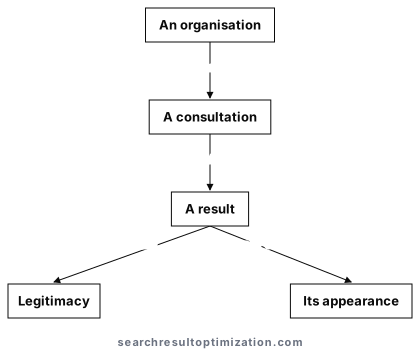
Activity designed to produce the appearance of engagement: the consultation that takes place after the decision, the advisory board without a mandate, the survey whose results are never published. Naming it is not an accusation. It is a category that a process can be tested against.
What is regulatory capture, and why does it appear in engagement work?
It describes a regulator acting in the interest of those it regulates. In multistakeholder settings it decides whether a neutral-looking platform is neutral. Where a process is convened, funded and staffed by one side, the result belongs to that side, whatever the invitation list says.
What is a grievance process?
The formal route by which affected people raise a complaint and receive an answer, with timelines and an escalation path. It is the part of engagement that works after the consultation has ended, and its absence is the clearest sign that a process was designed for approval rather than for consequences.
What is a materiality assessment?
The systematic selection of the topics that matter, ranked by their significance for the organisation and for those affected by it. It turns engagement from a general conversation into a list of subjects with owners.
What is double materiality?
The requirement to look in both directions: how sustainability topics affect the organisation financially, and how the organisation affects people and the environment. It matters because it moves engagement out of communications and into reporting, where a claim carries consequences.
| Who | What to do | Free means | What it shows |
|---|---|---|---|
| Searcher | Look for the two directions in the report: effect on the company, effect on the world | The report | Whether both were assessed |
| SEO | Name the topics and their owners on a public page | Your CMS | Topics that are traceable instead of general |
| Your site | Check your own domain; replace example.com with it | site:example.com intitle:sustainability OR intitle:report | Where your own topics are published |
What does the AA1000 standard add?
A framework for the quality of participation itself, with principles of inclusivity, materiality, responsiveness and impact, and a way to assure the process. It gives an answer to the question an executive actually asks: how would anyone verify that this consultation was any good?
What is free, prior and informed consent?
A right, in specified contexts a legal one, of indigenous and local communities to give or withhold consent before a project affecting their land proceeds. The three words carry the weight: free of pressure, before the decision, and with the information needed to judge it. A consultation is not a substitute for it.
What is the chilling effect in a consultation?
The silence produced by the fear of consequences, legal, professional or social. It is the most misread signal in stakeholder work, because silence in a room is routinely recorded as agreement.
What is a psychological contract violation?
The reaction when an implicit promise is broken: not a clause in a contract, but the expectation a community formed from earlier statements. It explains outrage that appears disproportionate to the formal facts, and it is the reason a small change can end a relationship built over years.
How can a consultation be checked before it is signed off?
By asking six questions. Who was named as affected, and who ranked them? What happened to the people who dropped out? Which claims made in the process carry a source? Who convened and funded it? What is the route for a complaint afterwards? And which commitment carries a date and a name?
Try it now
- Open your last consultation report.
- Mark every commitment that carries a date and a name.
- Think: how many are left, and what did the rest cost to produce?
The part of a report that has consequences.
| Who | What to do | Free means | What it shows |
|---|---|---|---|
| Searcher | Read the participant list and ask who is missing from it | The report itself | The groups that were never in the room |
| SEO | Publish objections and answers as a page, with dates | Your CMS | A record that can be cited later |
| Your site | Check your own domain; replace example.com with it | site:example.com intitle:consultation OR intitle:stakeholder | What your own site says about participation |
| Who benefits | In everyday use | How it pays off |
|---|---|---|
| Legal and compliance | Runs six questions before the sign-off | Processes that survive an audit |
| Management | Knows what the report proves and what it describes | Sign-off with open eyes |
| Content team | Publishes objections, answers and dates | Material that can be cited |
The report says the process was a success. What would prove it?
A changed decision, a named commitment with a date, a published record of objections with answers, and a grievance route that stayed open afterwards. Attendance figures, photographs and satisfaction scores describe the event rather than its effect.
First published 2026-09-16. Last revised 2026-09-16.