
On this page
- What it is
- Earned media measurement is the attempt to say what coverage you did not pay for is worth.
- The problem until now
- Reports counted what was easy to count: mentions, reach, sentiment, and a money figure that finance refuses to accept.
- What you can do from here
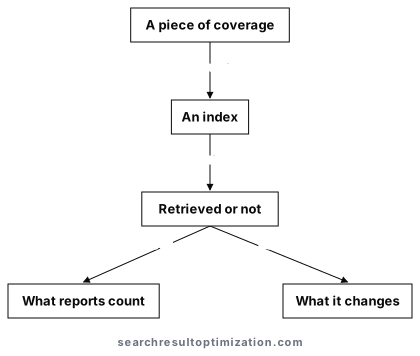
- You can separate outputs from outcomes, and you can test the part nobody measures: whether your coverage is retrievable, quotable and correctly attributed.
Contents21
Tests on this page you have run: 0 of 5. The count stays in this browser only.
Jump to a test5
Two disciplines measure the same coverage and never meet. Communication measurement counts what was published. Information retrieval decides what is found.
This page states what is settled in earned media measurement, and then the questions that decide whether a placement is retrievable at all. Every heading is a question. The answer stands directly under it, in plain words.
What is earned media measurement?
It is the attempt to say what coverage you did not pay for is worth. A press mention, an interview, a review, a citation in someone else's article: none of it was bought, so none of it has a price, and the whole field exists to put a defensible number next to it.
What do the reports count today?
Outputs first: mentions, reach, share of voice, page visits, content downloads. Then sentiment as a tone label, and message delivery as the question whether the key statements appeared. Conversions are attributed where the tooling allows it. On top sits Earned Media Value, a money figure built from advertising prices.
Why does finance distrust the value figure?
Because it is a proxy. Earned Media Value prices a mention as though it were an advertisement of the same size, which is a category error: an article is not an advertisement, its audience did not choose to see an advertisement, and the price of an advertisement is not the value of being mentioned. The measurement profession has argued against the practice for years, and the figure survives because it is easy.
| Who benefits | In everyday use | How it pays off |
|---|---|---|
| Management | Presents outputs, outtakes and outcomes separately | A report that survives the finance review |
| Legal and compliance | Avoids a money figure that cannot be defended | Fewer claims to withdraw |
| Sales | Speaks about effect rather than equivalence | Credibility in the room |
What is the difference between outputs, outtakes and outcomes?
Outputs are what you produced: pieces, mentions, reach. Outtakes are what the audience took from it: awareness, recall, understanding, favourability. Outcomes are what changed afterwards: attitude, behaviour, revenue, risk. Most reporting stops at outputs and then speaks about outcomes as though the two were the same.
Why is a baseline missing from most reports?
Because campaigns are reported as absolute numbers. Without a measurement taken before the campaign, an increase cannot be separated from a season, a news cycle or a competitor's mistake. A baseline costs one measurement and decides whether every later number means anything.
What is organizational impact, and why is it rarely shown?
It is the connection between communication and what the organisation actually achieves: sales, recruitment, cost of capital, licence to operate. It is rarely shown because it requires data the communications department does not own, and because a weak connection is more visible than no connection at all.
What does precision at k have to do with coverage?
Precision at k asks how many of the first k results are relevant. Applied to coverage it asks a question no media report asks: when somebody searches your brand and the topic of the article, does the article appear in the first ten results, or on page four? A placement that cannot be retrieved is an archive entry.
Try it now
- Take your best placement from the last quarter and note the topic it covers.
- Search that topic together with your brand name on Google.
- Note what you got, before you open anything else.
- Think: on which position does the article stand, and would a buyer ever reach it?
Whether your best coverage is retrievable or filed away.
| Who | What to do | Free means | What it shows |
|---|---|---|---|
| Searcher | Search your brand with the topic of the article and count the relevant results in the first ten | Google search | Whether the coverage is retrievable at all |
| SEO | Keep a sheet of ten queries a buyer would use and the position of each placement | Google Sheets | Precision at ten for your own coverage |
| Your site | Check your own domain; replace example.com with it | site:example.com intitle:press OR intitle:news | Your own pages that should rank beside the coverage |
| Who benefits | In everyday use | How it pays off |
|---|---|---|
| SEO | Measures the position of each placement for real queries | Placements that are actually found |
| Management | Sees which coverage is reachable and which is filed away | Budget aimed at reachable outlets |
| Content team | Writes statements that rank beside the article | Coverage that keeps working |
Why does position in a ranked list matter more than a reach figure?
Because reach counts an opportunity and a ranked list decides an encounter. Graded measures such as normalized discounted cumulative gain exist precisely because a result at the top is worth more than the same result further down. Coverage reports value both the same.
What is passage retrieval, and why does it change what a placement is worth?
Modern systems do not retrieve whole articles, they retrieve passages. The unit of value is therefore the paragraph that carries your statement, not the article that contains it. A long feature with your quote buried in the middle can retrieve worse than a short piece that states the same thing cleanly.
Try it now
- Copy the paragraph of that article that mentions you into an empty document.
- Put it aside for a moment.
- Think: does it still say who you are and what you claim, without the rest of the article?
Whether your statement survives being lifted out.
| Who | What to do | Free means | What it shows |
|---|---|---|---|
| Searcher | Read only the paragraph that carries the quote and judge whether it stands alone | The article itself | Whether the passage survives being lifted out |
| SEO | Ask for a short, self-contained statement in every pitch, and place the name inside it | Your pitch template | Passages that can be retrieved and quoted |
| Your site | Check your own domain; replace example.com with it | site:example.com "said" OR "according to" | Quotable statements on your own pages |
| Who benefits | In everyday use | How it pays off |
|---|---|---|
| Content team | Supplies one self-contained statement per pitch | Quotes that survive extraction |
| Sales | Gets a sentence a buyer can read alone | Shorter explanations |
| SEO | Judges a placement by its passage, not its length | A realistic view of what a piece is worth |
Why does entity recognition decide whether a mention counts?
A system has to decide that the string in the text refers to your company and not to a similar name, a product, or a person. Where that fails, the mention exists for a human reader and does not exist for any machine that answers questions about you.
What happens to mentions written with a pronoun?
They fall out of most counts. A paragraph that says the company announced, without repeating the name, is invisible to keyword monitoring and hard for systems that do not resolve references. The effect is systematic: the more naturally an article is written, the fewer of its mentions are counted.
Try it now
- Read the article again and mark every sentence that refers to you without naming you.
- Count them.
- Think: how many of your mentions would a keyword monitor miss?
The mentions that exist for readers and not for machines.
Why does dense retrieval change the vocabulary question?
Because a match no longer requires the same words. Coverage that describes your product in its own language can be retrieved for a query that uses none of your terms. That cuts both ways: coverage you never wrote can answer questions about you, and coverage that repeats your slogans may retrieve for nothing at all.
“retrieval can be practically implemented using dense representations alone”
Study: Karpukhin et al., Dense Passage Retrieval for Open-Domain Question Answering, arXiv 2004.04906, 2020. https://arxiv.org/abs/2004.04906
What does term weighting say about industry language?
That common words carry little. Weighting schemes such as term frequency with inverse document frequency exist because a word everyone uses cannot distinguish anything. A press release built from category vocabulary is expensive to produce and cheap to retrieve.
What do the topics in your coverage look like when nobody assigns them?
Different from the tag list. Statistical topic models group coverage by what the texts actually share, not by the categories a monitoring service offers. The clusters that appear without being asked for are the ones worth reading.
Why is one search engine not a measurement?
Because different systems rank differently, and a placement visible in one can be absent in another. Combining several ranked lists, for example through reciprocal rank fusion, is standard practice in retrieval and unknown in media reporting, where a single screenshot still passes as evidence.
Try it now
- Search the same query on Google, on Brave Search and on Mojeek.
- Note the position of your placement in each list.
- Think: which of the three would you have put in the report?
How much a single screenshot leaves out.
| Who | What to do | Free means | What it shows |
|---|---|---|---|
| Searcher | Run the same query on Google and on one independent engine | Google search, Brave Search, Mojeek | How differently the same coverage ranks |
| SEO | Record positions from two engines for the same ten queries | Google Sheets | A range instead of a single screenshot |
| Your site | Check your own domain; replace example.com with it | site:example.com | The order of magnitude your own domain reaches |
What is multi-touch attribution, and where does it fail for earned media?
It is the attempt to divide a conversion among the channels that touched it. For earned media it fails twice: the touch often happens without a click, and the click that does happen carries no campaign parameter. The honest version states which part of the journey is unobserved rather than hiding it in a model.
“The inference about the influence of each channel plays an important role in budget allocation and inventory pricing decisions”
Study: Li et al., Deep Neural Net with Attention for Multi-channel Multi-touch Attribution, arXiv 1809.02230, 2018. https://arxiv.org/abs/1809.02230
How do publishers that cite the same sources reveal a structure?
By citing each other and the same origins. Co-citation and bibliographic coupling, borrowed from bibliometrics, show which outlets move together and which one starts a story that the others then carry. That map explains where to place one piece instead of ten.
What belongs in a report that respects both disciplines?
Outputs with their date, outtakes where they were actually surveyed, outcomes where the data exists, a baseline, and the retrieval part: whether the coverage is indexed, at which position it appears for the queries that matter, and whether a passage from it can stand alone. Anything else is a screenshot with a number under it.
| Who benefits | In everyday use | How it pays off |
|---|---|---|
| Management | Reads outputs, outtakes, outcomes and retrieval in one place | Decisions on a complete picture |
| Legal and compliance | Sees which parts are observed and which are modelled | Claims that hold up |
| SEO | Adds index and position to the report | The part nobody else reports |
Our coverage is up and our referral traffic is down. What does that mean?
It usually means the coverage is being read on the result page and in generated answers rather than on the publisher's page, and that the publisher's page is where the link sits. Check whether the articles are indexed, at which position they appear for the relevant queries, and whether an answer engine quotes them without linking. The decline is a retrieval question, not a public relations failure.
Try it now
- Open Google Search Console and compare impressions with clicks for the last two quarters.
- Search two of the queries by hand and look at what stands above the results.
- Think: was the answer already given before anyone could click?
Where the reading moved to.
| Who | What to do | Free means | What it shows |
|---|---|---|---|
| Searcher | Search the article title and see whether an answer appears above the results | Google search | Where the reading happens now |
| SEO | Compare impressions and clicks for the queries the coverage targets | Google Search Console | Demand that is met before the click |
| Your site | Check your own domain; replace example.com with it | site:example.com inurl:news | Your own newsroom pages, which the coverage should not have to replace |
The board asks what the coverage was worth. What can be said honestly?
That outputs are known exactly, that outtakes require a survey, that outcomes can be connected where the data exists, and that the retrieval part is measurable today at no cost. A number without that structure is a guess in a suit.
First published 2026-09-16. Last revised 2026-09-16.